

Podcast | Archetypal Depth, Mana vs. FIMI
A comparison between the EU and Disinfolklore’s complementary means of combatting mind-hacking propaganda.


Archetypal Depth: 6,000 Years of Indo-European Culture
The European Union acknowledges that Foreign Information Manipulation and Interference (FIMI) narratives are repetitive and predictable.
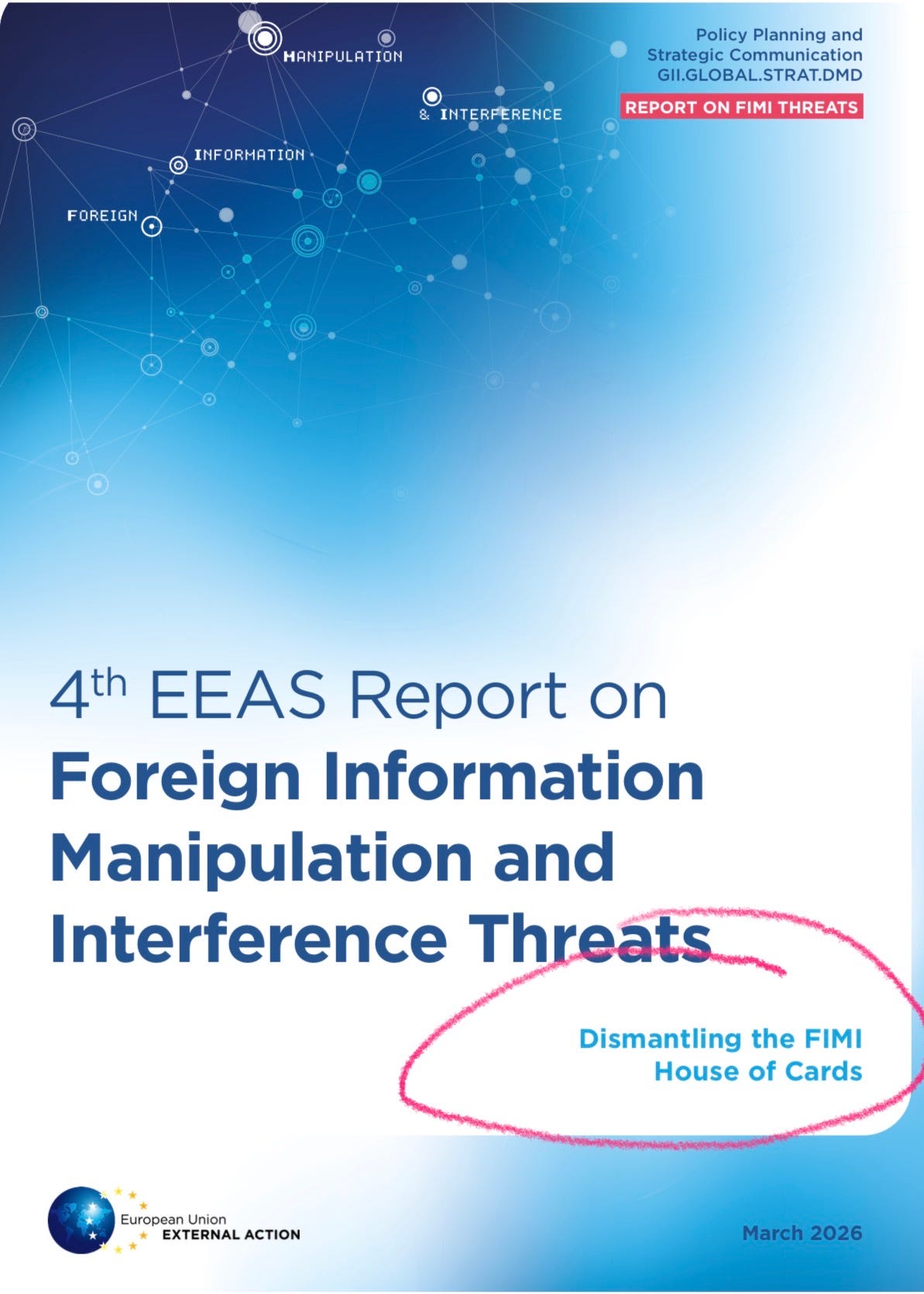
It documents the three-phase Russian election interference playbook: delegitimise leadership, weaponise divisions, undermine electoral integrity. But it treats this repetitiveness as a feature of Russian operational doctrine. Disinfolklore goes deeper.
My framework traces these narrative structures, these archetypes, back through 6,000 years of Indo-European culture. The inner-outer realm switching that I documented at Stanytsia Luhanska, where Russian-speaking Mariupol mothers were instantaneously re-archetyped as dead Ukrainian Nazis — that is not a Russian TTP, not a Russian tactic, technique, or procedure. It’s an ancient mechanism of exclusion and dehumanisation that Russia has weaponised. The Trito myth, the wolf in sheep’s clothing, the trickster tale — which the Middle Eastern countries are living right now. You give Donald a gold-plated Boeing 747 and all you get in return is 100 Shahed drones attacking your infrastructure. When you say to Donald, “But you said you’d protect us,” all you get is, “How about another jet?”
The trickster tale. We learned these when we were children and these have been passed on and on, whether in the Arabian Nights or Chaucer’s tales or folk tales collected by the Brothers Grimm, or indeed in the folklore which Mockers reads on Volya Radio each morning. These are structural patterns that predate any state actor. That’s the depth I help provide.
Why this matters operationally: if you only understand FIMI as Russian or Chinese state behaviour, your response is limited to targeting those states. If you understand it as a weaponisation of deep archetypal structures that are hardwired into Indo-European cognition, you can build genuine cognitive immunity because you can teach people to recognise this pattern regardless of who deploys it — whether it’s in your own household or in your own community or from Russia.
The Missing Mana Dimension
The European Union report exhaustively catalogues channels and observables. It counts, it maps, it attributes. But nowhere does it ask: what is the energy inside the meme? What is the affective charge that makes one piece of content resonate and another fall flat?
My concept of mana — the energy embedded in informational units that impacts moods, attitudes, intentions, and motivations — is precisely what the EEAS framework lacks. The report notes that most AI-generated FIMI content is low quality and generates limited organic engagement. It notes that Storm 1516 is the exception, but there’s no framework for explaining why. In my terms: most FIMI content carries weak or misaligned mana. Storm 1516 succeeds because it plugs into authentic fears and archetypal structures that carry real affective charge.
My Finding Manuland research — you’ll see the Manuland section on disinfolklore.eu — traces the etymological and semantic and hermeneutical link between the mana energy, the M-N in mana and energy, and money — it’s in M-money as well — through 6,000 years of M-N sound patterns. The EEAS report documents Russia’s 146.3 billion rouble media budget, about 1.56 billion euros. The linguistic archaeology tells us something the budget line does not: money and mana are cognates. The resources flow where the energy is. Understanding the energy is understanding the resource allocation…
Available wherever you get your podcasts or here:
