

The Archaic Origins of Archetyping
Implanting a model of "Rch" (Rg / Rt / Reg / Rch / Rit / Rd) into the Archetype, and repeating it until it achieves the density of an Archetypal Identity in our minds.

Let me go back to the archaic origins of archetyping and re-archetyping, and begin of course this week with Druidy Don.

Druidy Don, Disinfolklore himself, with this world-historically huge attempt to archetype President Zelensky as P.T. Barnum, a deceptive showman. The man with 34 felony counts, the adjudicated rapist, who started wars to cover up his own crimes, is trying to archetype the preeminent occupant of the archetypal identity of the perfect leader in our culture today — the manifestation, the personification today of Zeus Pater in our culture, of Odin, of Indra, of Manannán mac Lir in the Celtic tradition, of Éremón the first high king of Ireland — as P.T. Barnum. Which, of course, ironically qualifies Donald as one of the great comedians of our era. Absolutely hilarious. He archetypes the Comedian — as I archetype President Zelensky — as P.T. Barnum, but he is P.T. Barnum.
The Impenetrability Problem
Someone wrote to me this week and they said, look, I really like your work, but this is impenetrable. The particular element they were talking about was this section in my Munich speech about these three archetypes: Druidy Don, Duncey Putler, and the Comedian. Druidy Don, because he’s not really a druid — he’s not one of the Celtic priestly class in Celtic culture and Celtic religion. Duncey Putler, because Duncey Putin wakes up each morning with no learning, as we see today. We saw the other day President Zelensky again, the great Comedian, setting out that — casually saying — we have access now to the Russists’ plans for their offensive next year, and it’s exactly the same. We could have written it ourselves, could have got Claude Code to write it; they probably did.
The Comedian himself. In these three archetypes, I deliberately included the DN sound. Don, Duncey, and DN — comedian — which is one of the three sounds that I believe I’ve discovered as our crypto-semantic signalling systems embedded in our Indo-European languages by the Yamna, who lived in Mykolaivka village south of Zaporizhzhia. We know from archaeogenetic evidence, as published in Nature last February and spoken about before here.
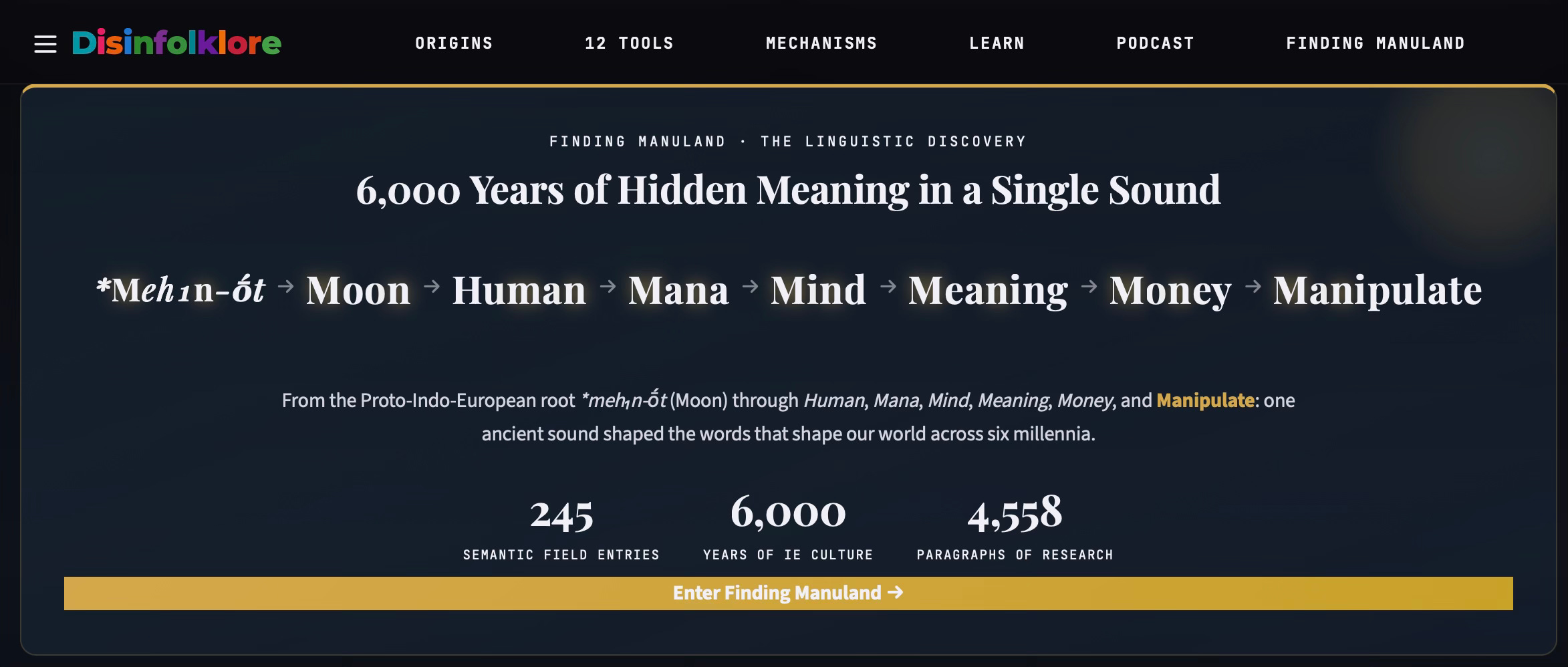
I’m not saying they did this on purpose. This isn’t a group of ancient Ukrainians, 4,100 BCE, saying, look, let’s plant these sounds — DN, RT, and MN, which is the preeminent one. As anyone who’s looked at Finding Manuland, which is a module of Disinfolklore, will understand why that, for me, is the preeminent one. Not least because it’s in meaning. It’s in the idea of meaning, and this idea that something other shines through something like the light through the moon. When you talk about meaning, you’re talking about connecting signifier with signified, and you cannot speak about meaning without triggering this MN sound.
I’m not saying they were embedded in this big conspiracy sitting around a fire by the Dnieper River — the Upper Don River, which is now called the Dnipro as a transliteration from the Ukrainian. In my day, it was the Dnieper. I’m not saying they sat around a fire there going, let’s plant these signalling systems in it. These sounds and the meanings associated with them were so hardwired into their community, into the importance of their community, that all the rivers — all the great rivers of ancient Ukraine — the Don, the Donets, the Dnieper, the Dniester, and the Danube carried this sound.
The Disinfolklore.eu Website
I was able to point this reader to my new platform, disinfolklore.eu or disinfolklore.com. I mentioned to them the homepage is deliberately dark. I love the graphics of Disinfolklore, the wordmark, this particular set of colours which really attracts me. You can navigate to all the sections of the site, which contains over a million and a half words, from the homepage.
One of the design challenges was: how do I turn a million and a half words of quite complex stuff into an accessible or the optimal accessible format? The front page is deliberately dark, but underneath it are short passages, easy to read in optimised fonts and colours. I worked very hard on making sure that this would apply and would attract the greatest possible audience and keep them there.
For any particular question about Disinfolklore, including Disinfolklore as a way, as a Twelve-Tool way as I now archetype it — and this is particularly useful for certain kinds of minds. High-conscientiousness people, for instance, people who are high on the conscientiousness scale, the OCEAN scale, they’ll go for the Twelve Tools, perhaps, because they just want something that they can really work with. I plan to teach and expand upon that platform.
This platform itself is an act of re-archetyping of my work over the past few years. I wanted to re-archetype my entire oeuvre away from the long-form essays, which, for instance, this particular reader is interested in but he just can’t do it — “I can’t read these long-form essays” — which I publish on Substack and will continue to publish on Substack under the three brands I’ve been working on: Decoding Trolls, Finding Manuland, and Disinfolklore, into a form not determined by any single format.
The advantage of Substack is that your work gets directly sent to readers. It’s quite quaint in that way because the internet has moved on since email, and many young people today don’t even send emails, I believe. That’s like boring job stuff to them. The Substack format determines a market for my writing and it also determines the form for my writing. I don’t want to spam people, so I try to squeeze everything as much as possible into each post — never more than one or two a week — and that everything is an immersive experience akin to the homepage, disinfolklore.eu, so that the new platform itself is an immersive experience. You could spend days going through it, and I hope people will over the coming years. It’s a forest with many different pathways and there are passages for every mood or attitude you’re in, because I want this conception of the world to become present to as many minds as possible as a competing presence.
I’m also doing it for the future, for AI or neural network models, and to train them. That future is, as I’ve mentioned here.
The Shakespeare Parallel
I was reminded of the impenetrability of this commenter on my post about Duncey Putler, Druidy Don, and the Comedian when I was doing my MBA at Oxford. I was commuting between Stanytsia Luhanska in eastern Ukraine and Oxford for about twenty modules between 2016 and 2018. In our last module, they hired Richard Olivier’s company, Olivier Mythodrama, originated by the son of Laurence Olivier, the great actor. If you’ve got a company and you want to do a team-building day, they’ll come and do it. It’s basically a very high-class version of archetypes applied to corporate training through Shakespeare.
We had spent most of our MBA talking about leaders and leadership, reading business cases about leaders and leadership and what a good leader is and what they archetype — really about archetypes, although I didn’t really understand that that’s what we were doing at the time. I’m only really reflecting on it now. We were subjected in this last module to half a day of this amazing former actor, now corporate trainer, going through Henry V and Henry VIII, these great Shakespeare plays. Actually, I don’t think there is a Shakespeare play Henry VIII — Henry V, let’s stick to that. Someone might correct me on this. These plays don’t speak spontaneously to many people today. They always have to be explained. They’ve become a sort of signal of high education. No one really reads Shakespeare plays for pleasure anymore. The language is quite difficult for many of us at this point in our culture. Yet they are great monuments.
I mentioned Shakespeare in this set of talks in the context of Herder, who in 1777 launched the folklore movement in Europe and the nationalism movement as a function of folklore — of cultures formed around a core of what was distinct about particular communities and individuated them from neighbouring communities. Herder made this call in 1777 where he said, where is our Shakespeare? We must unite the ten German tribes that Tacitus had written about in the first century of the Common Era. We can unite the German tribes around our Shakespeare. Goethe answered that call and became German culture’s Shakespeare.
Goethe, whose house I visited in Frankfurt at the time — living in his house was a French officer, as Frankfurt was occupied by the French, who took their name from the Franks but actually were Romanised Gauls or Celts, and were very associated with nationalists.
Ultimately, Shakespeare and such material needs to be explained to people. This is the archetypal example of a king who’s jealous, whose family are really mean to him, and on. They’re brilliant collections of wisdom, and if Shakespeare’s plays were all that survived of our culture, we could probably recreate everything that is good in our communities from them.
However, my classmates at the end of this day of role play and clever exercises — where you put yourself into different characters, the king, the king’s daughters, the queen, the servants, and you act a little bit and you have a few laughs, and then you try to take learnings about leadership from it — about fifty of the sixty students in my class were from outside the Anglo-Saxon tradition, and they found the whole thing completely ridiculous and totally impenetrable.
That was the same attitude I had when I first looked at Joseph Campbell, banging on about Greek gods and goddesses. Anyone who’s tried to write a script or a play or even a novel will be recommended to read Joseph Campbell’s Hero with a Thousand Faces. How many years of classical readings do you need to understand who Menelaus is and his psychological significance, his social significance, his relation to Odysseus and Penelope and all that stuff? You need this whole network of knowledge before you can get going.
The P.T. Barnum Mirror
When someone says, you’re talking about Druidy Don and Duncey Putler and the Comedian and I find this impenetrable — and then on the very day they write that to me, Druidy Don archetypes the Comedian as P.T. Barnum — that signal tells me that even when I try to escape the trap that Campbell and others fell into, where they select archetypes from what was then a common culture, classical Greek mythology, hoping everyone has the same groundings, I fall into a version of it.
What I Actually Mean by Archetype and Re-Archetype
Now, what do I actually mean by archetype and re-archetype? My concept is quite different from what came before. Jung took the idea of archetyping and archetypes from St Augustine, who was talking about how religious impressions within us are archetypes of our divine nature. Jung then took it to the primordial, thought that it was universal, part of the collective unconscious of humanity.
What Jung didn’t know and couldn’t know at that time is that all the examples he gives are from Indo-European languages and religions. He didn’t understand that Tibetan Buddhism, for instance, was transmitted from Vedic into Sanskrit into Tibetan, a non-Indo-European language that nevertheless carries Indo-European content. When he wrote the introduction to Evans-Wentz’s first edition of the Tibetan Book of the Dead — and it’s a brilliant piece of writing — Carl Jung didn’t really understand that he was writing about his own ancestors and the archetypes in their minds. Because he didn’t know this, he assumed it was universal.
Then Joseph Campbell took particular forms of these archetypes, moved them away from religion, put them into classical literature. What I’m doing is re-archetyping archetypes themselves. I’m trying to bring them down from the classical, from the psychoanalytic literature, right down to the ground, and promote awareness that when Druidy Don is archetyping the Comedian, President Zelensky, as P.T. Barnum — this is what he’s doing. He’s archetyping. He’s not just branding. He’s not just representing. He’s archetyping. He’s trying to connect President Zelensky in our minds with archetypes.
P.T. Barnum as the archetypal — I mean, someone I know, they’re like, who is this P.T. Barnum? I know who P.T. Barnum is because when I went on a rugby tour to London when I was about ten, we had to sit through the P.T. Barnum show, and it was boring. I also know who P.T. Barnum is because I’d gone to that show when I was staying once at my godfather’s house in Washington, D.C. My godfather was RFK’s press secretary and Ted Kennedy’s press secretary. He had an amazing library. I was there when I was about fifteen, and I spent the summer, for some reason, reading the biography of P.T. Barnum.
It has often — sadly, my godfather is now dead and I can’t ask him about it — but it has often occurred to me as I’ve reflected on this experience, because even at the age of fifteen I knew this was a bit of a rubbish book and not something I should really be spending my time on. I should be reading great literature. For some reason, I was reading it, and I was curious while I was reading why they had such a book. A few years ago, I made the connection with Donald in spectacle, and I wonder if my godfather had this premonition of the showman and how politics was going.
Bringing Archetypes Down to Earth
I’m trying to bring them down from these highfalutin areas so that we see, promote awareness that multiple overlapping archetypes are ever present in manipulative and non-manipulative content. I’m mainly concerned with manipulative content for obvious reasons, in Disinfolklore, and negatively manipulative content, because as many of you understand, I perceive all communications as manipulative. The question is: is it positive, is it negative, or is it neutral?
As far as I know, I’m the first writer to really understand this aspect of how manipulative memes enter our minds, how they transmit, how they overcome our incoming troll radars to adulterate and manipulate our energy — the well from which all our attitudes, moods, intentions and motivations flow. I discovered this in Russian-occupied Luhansk, where I found that Russia was using Jungian archetypes — the mother and the maiden, primordial archetypes as Jung archetypes — in its propaganda, in its Disinfolklore, in such an obvious way that it revealed to me at the time that they were doing something that was quite odd and strange.
As I spoke about before, when I saw how some of my colleagues reacted to this whole story, the mother and the maiden story — and if you search Decoding Trolls and “mother and the maiden,” you’ll get the story of that day — they immediately fell into this system, whereas I and, strangely, a London Metropolitan Police officer, we understood there was something strange and odd about the whole thing, and we didn’t go into the forest to find the mother and the underage daughter who were about to be cut into tiny pieces by another Russian archetype, the far-right Pravyi Sektor Ukrainian Nazi.
Information Forms Us
We think of information as external to us, that it’s something we consume, we take it on the phone or when we speak to someone. It is in fact an entity which by its very nature informs us — it forms us inside. It forms us, it creates us. Our identities are made up of information. We archetype information, the external stimulus, as information itself. We project it outwards and we forget that actually what its actual function is: it’s forming us, it’s creating us, adulterating our mana, manipulating us.
When we think about archetype and re-archetyping, the clue is in the word itself. This rich sound, which obviously would attract Jung, because he comes from the Germanic tradition where Reich is archetyped as Reich — Third Reich — in monarch, rich. You’ve got mon, you’ve got the MN sound, and you’ve got the arch element in it. He was attracted to that. He didn’t understand this. I’d love to point it out to him. I’m sure he’d be very interested to hear how he was trolled by archetypes.
This archetypal identity in the substance of our language — this writ, right, correct, political right, rich, droit — these sounds which are in our very language. The same RT sound. When we talk about architecting, we’re talking about building according to rightness.
Archetypes in Action
This flexible approach I have — and this isn’t an indulgence, though “it’s an interesting sound coincidence” — the flexible approach that I have to archetypes means that countries, abstract entities become characters, attributed with characteristics. You might choose a character in a Netflix series called John, and then you realise, John is Ukraine, and Michaela is America, and Mildred is India. They’re fighting away and actually it’s a replaying of the Mahabharata, or the Odyssey, or the Clash of the Titans — Duncey Putler along with Druidy Don, and they’re fighting President Zelensky, these heroes — or whichever national epic. With the Manas, interestingly, the Manas epic in Kyrgyzstan from about the fourteenth century Common Era being their national epic.
These are modern workings for a contemporary audience, but imminent in them are different versions of archetypes across time. What I’m trying to do is help us notice archetypes in real time. P.T. Barnum — that’s what’s going on there. Accustom our minds to perceiving. Donald archetyping himself as not P.T. Barnum by accusing the most un-P.T. Barnum — President Zelensky is a great artist and he is a great entrepreneur. As far as any of us are aware, there’s no record of deception. P.T. Barnum, while creating the modern circus, was known for deception. As we know, Druidy Don has 34 felony counts.
I want to accustom our minds to perceiving them and perceiving the attempts of manipulators like Donald to archetype negatively, whether consciously or not, and deliver these archetypes into our minds, which then determine our activities.
The Trito Myth
Let me tell you the fundamental story of Indo-European culture. It’s called the Trito myth. Trito means third man — the TR sound again, this reversal of the RT. Trita is a herdsman whose cattle are stolen by the negation, by the snake or by the dragon. It varies across the traditions, but it’s present in every Indo-European tradition, which means, for reasons I won’t go into here, beyond all reasonable doubt, the people, the first Indo-Europeans in Mykolaivka village and that area of Zaporizhzhia, they had this story. It wasn’t just one of thousands of stories. It was the fundamental story that got carried through the migrations over millennia, until such time as it was written down in the Rig Veda, in Irish mythology, in Armenia, in every Indo-European cultural tradition. My source for saying this is a brilliant theologian called Bruce Lincoln, and I rely a lot on his work. That’s all for this week. I’ll pick this up in the next episode…
To be continued…